
At the Window
no. 48

After school, we take Ethledore Street so that I can go to the mailbox. Our mailbox is on the corner, not at the end of our driveway. I pull up alongside Anna’s fence and put the car in park so I can walk over. I get out of the car and shut my thumb in the door. “Shit, shit, shit,” was all I could mutter. It throbbed. I could see blood pooling under the surface of my nail. “Mom, that makes me scared,” Leif said. I could see his arms protecting his chest, protecting his heart. “It’s okay, Leif. I am okay. Nothing is happening to me.”
I understand him. Hiding under the bed, not getting out of the truck to go to school, and now this—me smashing my finger in the door. He is watching for anything that might take his mom from him. Dad is gone, at least for now. And he can’t lose Mom too. He has big feelings with me sometimes. I think he wants to know if there is anything he could do that would make me leave, or push me far away like Dad. He wants assurance. He wants certainty. He can’t lose Mom too. So much of Leif’s story is my story too. Little by little, I will share that with him—how you can miss someone who is still alive. I will tell him what I know about losing a parent, at least temporarily. It hurts. It’s a loss. It’s a relationship interrupted—not exchanged or replaced. The ache buries itself deep and does not easily release its grip. The sadness, the fear. How can I manage without Dad? Leifer and I didn’t prepare Leif for this. But Leif and I look back over time, and we talk about our stories. We talk about Texas and Peru. And we dream about what will be once we return to Peru.
Seneca writes, “The life we receive is not short, but we make it so; nor do we have any lack of it, but are wasteful of it.” This sentiment lingers with me as Peru urges me to return once more—where we are together with no appointments or obligations, except the ones we have to each other. My time belongs to the boys. Just to be—with Leifer and the boys. To sit with them, and Abuelita, and Abuelito, while discomfort and loneliness creep in. The loneliness wanders and weaves along with the pacay trees and the pot of soup on the fire. But I have already pushed through it once. I can again. To connect, and not withdraw. To speak up at the risk of mostly not being understood. To find a way. To let the loneliness be.
Leif got out of bed the other night, as he sometimes does once Enzo and Lucca fall asleep. He wanted to put aloe on his bug bite. “Do you remember when Fran gave me the plant that had aloe in it for an ouch?” he asked. Yes, I did remember. Leif and I went to Fran’s when I was a new mom—overwhelmed and lonely. Those days were long, too.
We fill our final days. I take the boys to the beach on a warm, sunny day. As a teenager, I once jumped into my friend’s pool with all my clothes on. It was so freeing. Now the boys in the ocean—feral and free, as my friend says. Once the cold seeps into their bones, they hop out. They make sand angels. The grains are coarse and big and warm.
“You make the past known in order to know yourself as changed.” —Melissa Febos
I dreamt last night that my mom told me that when I had stomach aches as a kid, she knew she had a part in causing some of them. I told her I was just trying to piece it all together and make sense of my childhood. That I loved her—and that at times, my heartbreak over her felt unbearable. My mom and I have had one long conversation over forty years. It’s far from finished. The bones are there. The shape. The love—always there.
I had terrible stomach aches as a kid. Sometimes it would turn into something worse—I would make myself sick. It would happen the night before something; my anticipation was excruciating. I remember my grandparents coming to visit, and the night before, I was so sick. I would get terrible shakes and wonder what was happening to me. I feared nighttime. I couldn’t make sense of it. I was scared—scared that I would always feel bad. My body knew, and my head didn’t. I watched everything around me, studying facial expressions and listening for tone. I felt like the family memory keeper. I still do.
I was a nervous child. When my parents left me at home alone, I would first make myself busy playing. Eventually, I would resign myself to sitting at the window, watching for their car. The windows were low, and I could rest my elbows on the sill, leaning forward. I would ask my mom what time she would be home and watch the clock. If the minutes passed beyond when she said she would return, I feared something bad had happened.
I went everywhere with my mom—often mundane places. I didn’t want to be without her. The grocery store, the dry cleaners, the post office. We would go to Picky’s Pantry for a fountain drink. I was her shadow. She ran into people she knew all the time, and I would listen to the conversations, rarely adding my own words.
I don’t know if my parents knew what to do with their nervous child. They were empathetic, but at first, I had no words for it. Certainly not “stress.” “What could you be stressed about?” That was not an easily answered question for me. And besides, my stomach aches—I believed—were an illness, something that would be fixed by doctors and medicine. My thoughts return to my childhood often, and I worry about how I will manage the trip and keep it all together for my boys, for Leifer. Will my stomach hold?
The bus cradled us, rocking from side to side. First the blistering heat, then the fresh breeze. We climbed and climbed, cutting through switchbacks. There are four points along the trip—the beginning, the lunch stop, Huaraz, and the end. I rested in the morning and in the afternoon. Lucca did the same. I forgot my worry—about the kids, about everything. The bus did the hard work, keeping the boys safe. I started to talk to Leifer about our time apart, and we got interrupted. I am still that girl at the window, watching and waiting. But the conversation didn’t seem to matter after that. We had already done the hard, and there may be more ahead—but I could let it be for now. I didn’t want to tug at the already unraveled string and make it longer.
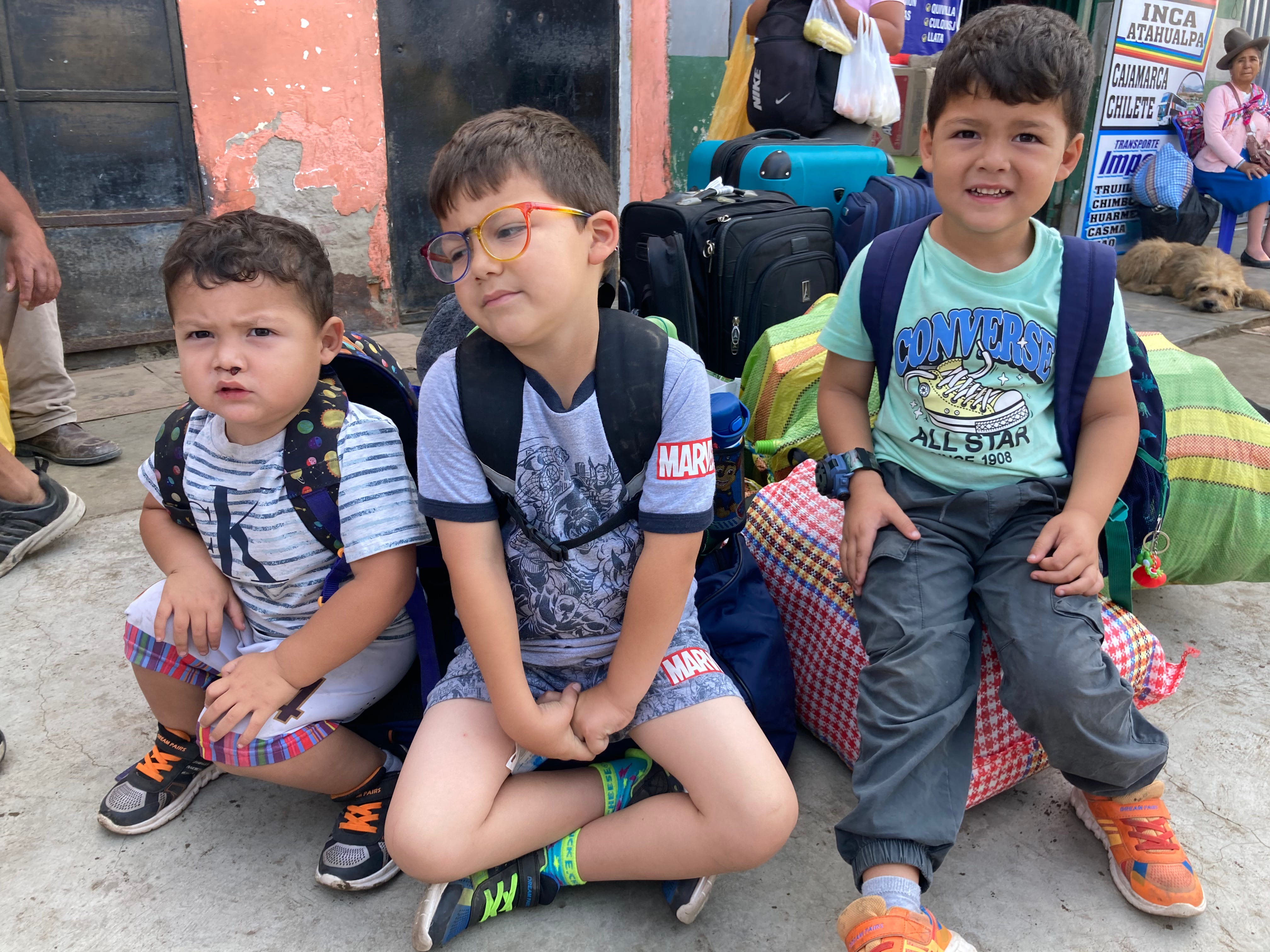
Enzo turned five. We celebrated everywhere we could—at school, with family in California and Peru. The parties bring us together. We play, we sing, we laugh. There are different languages and cultures, but we all join in. We eat chocolate cake.
We are whole once more. The boys are at ease in Peru. They join in easily with other kids at the playground. They carve out space for themselves. They go next door with their primo to buy pizza and play checkers while they wait. Leif teaches his cousins Blue Shoe—that’s how they pick who’s “it” for tag. If you get tagged, you become a banana, hands together above your head. They play for hours, running back and forth. Leif laughs easily. Enzo sticks with the older kids. Velma told me I would have more to write about in Peru—she was right. Lucca follows Leifer everywhere. He wants to be held by him, and I’m so relieved. Leifer changes him, and I hear them giggling from the other room.
We brought games up to the mountains. Leif and Enzo played Go Fish with Abuelita and Abuelito. Leif learned “tiene cuatro.” Abuelita rarely played any cards, so Leif figured out she was a good person to ask. Abuelito got bored halfway through and surrendered his cards, walking off. Playing chess with Enzo is like watching water slowly drip from a pipe. He wants to know what I will do before he moves his piece. He considers everything. He will not go down without a fight.
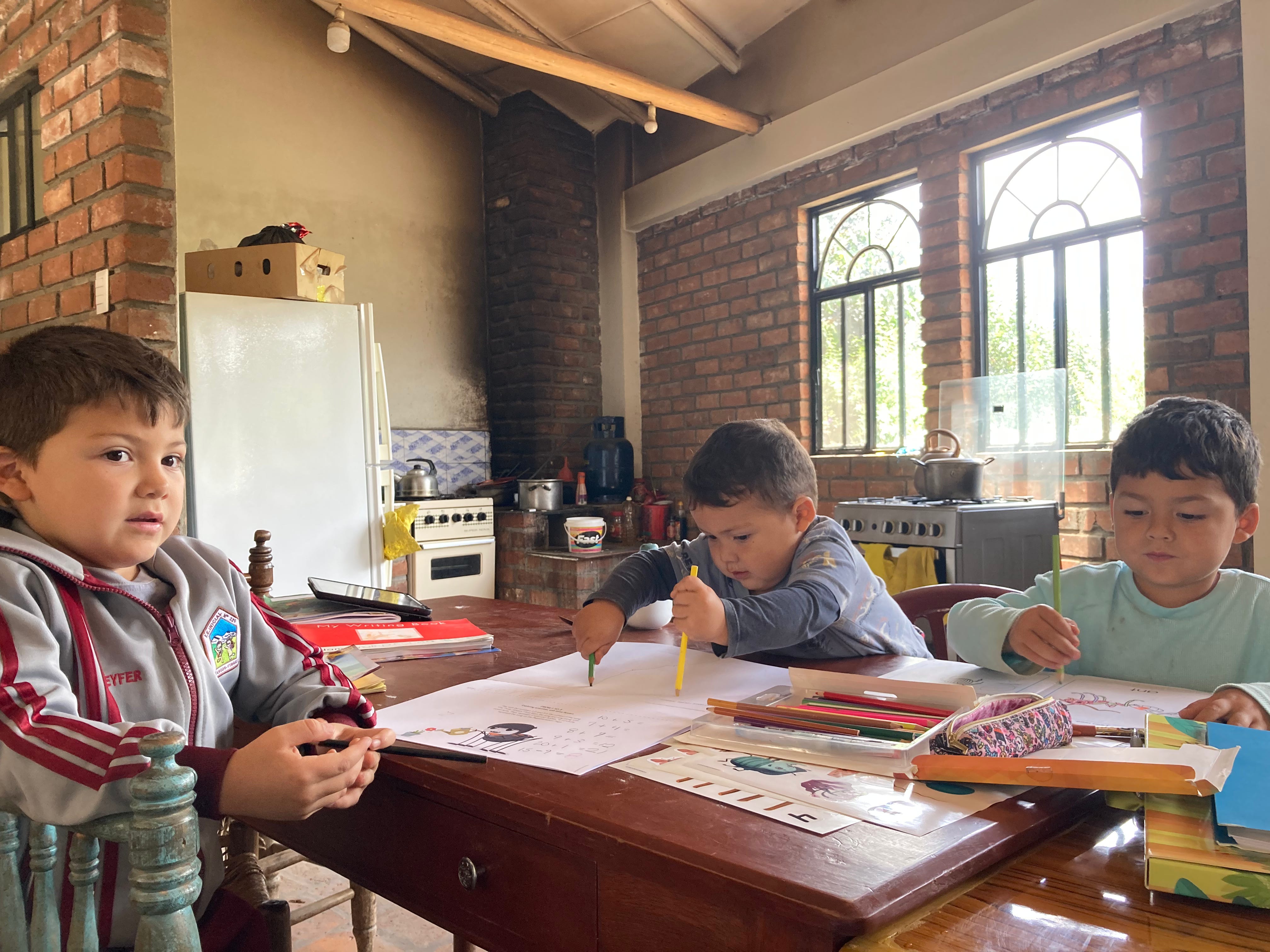
Up here, I am mom and teacher. We start the morning with a walk, then gather at the kitchen table. Enzo practices his letters, Leif does addition, Lucca colors. I move between them all. By eleven, they don’t want to sit anymore—and I’m ready for a nap.
I tell the boys we have two homes now—one in California and one in Peru. It feels like we are in a serious relationship with Peru, past the first awkward dates and into something more settled, where we think maybe this could work. I think about the gift of time we have been given. Seneca says life isn’t short—we squander it. And I wonder if here, in these moments, we are not squandering it. We feel whole. Like this time is ours—and not for someone else.
I am proud to share that my mom is 25 years sober. She shares that her very worst time has turned into her greatest gift (and mine too).
To my readers, my Substack is free. Thanks for showing up, supporting me, and my work. Writing can be lonely, but you all make it much less so. If there is anything I can do for you, don’t hesitate to ask. Until soon!
Beautiful, Abby
I am so incredibly proud of you and your mom and love you both dearly. I hope your time in Peru with your family will be better than what you can even imagine.