
Along the Canyon
no. 51

Huaraz to Lima on a 12-hour bus ride. Then Paracas, Huacachina, Nazca, and Arequipa. We head from the North to the South. I read about the coast, the valleys, and the mountaintops. Complex societies were built in this geographically diverse landscape- the Inca Empire was only a small part of the history. Cotton and corn are grown on the flatlands. Potatoes on the slopes of the Sierras. Alpacas and llamas in high elevations for wool. Much of the ancient world was disrupted by Spanish colonialism. Very little has been written down, and much of what was came from the Spaniards. However, upon second examination, many of the stories and life itself are documented in textiles and the quipu, knotted, colorful strings that recorded time, trade, and things. Many threads of the indigenous continued on- Quechua not stamped out.
In Paracas, we went for an ocean cruise to the Islas Ballenas. Our guide was Peruvian. We learned from him that his wife was from the United States but has now lived in Peru for 20 years with their son. Home-schooled. I wonder if I am putting off the inevitable. I ask myself, could I live here? Building a new life is slow, each step tough like climbing through the canyon. I wonder how the condors learn to harness the thermals. To find symbiosis with their environment, so it’s effortless.
He gave us a contact to help with Peruvian papers. Working on Peruvian papers would require my commitment to reside for a minimum number of days each year. I wanted to ask for his wife’s contact information. But I cannot commit to a life permanently in Peru, at least not yet. I don’t think we need to abandon our plan. We know what’s ahead of us at least for June and July, then after that, what invisible currents are we riding? Where can we trust the currents already carrying us?
Arequipa, 3 AM. We are on the final leg of our trek to get to the condors. They thrive at the edge of our world, it’s just the beginning of theirs. I am depleted and tired, jostled for many hours. We must go, right?
Cold and dark. Leif didn’t want to get out of bed. We knew Colca Canyon was still hours away. Bring medicine for headaches and vomiting, they reminded us before the trip. Once you’re on the bus, it’s no turning back. Some people also live at the edge of this world. They grow and raise food and animals. Potatoes thrive. Alpacas, llamas, cows. Our schedule is relentless, pausing for nothing. The continuous movement feels essential.
The road winds like a slithering snake. But I’m happily surprised it’s paved, having been on other mountainous dirt roads. There are still bumps along the way. My body is thrown around the curves, folded tightly in my seat. I feel bruised and battered. We are given fleece blankets, our only source of warmth on an unheated bus. There is one driver and a tour guide for our twenty-passenger van. We stop to pick everyone up from their hotels and then start on our way.
The condors are at the top of the canyon. There are steep cliffs and a river tucked deep below. They say Colca Canyon plunges much further than the Grand Canyon. The condors glide, harnessing the energy of the thermals. They are agile and light. They make a show for us, taking joy rides. They seem content that the rainy season is over, and the sunny day is perfect for flight. They are assured their wings will carry them; there is nothing strenuous in their subtle movements. Leifer counts twenty condors. He has told me stories of condors tipping cattle off the sides of cliffs, scavengers who feed on what’s already expired. We walk further into the canyon so we can look from another angle. I move slowly, they say it helps to minimize the effects of the altitude, but it seems like the only possibility. I heave my legs, and my breath quickens. The condors congregate on one giant rock. They take turns gliding away and returning. It looks like play. Or exercise. Or stretching. This is their place. They belong. They ignore their observers.
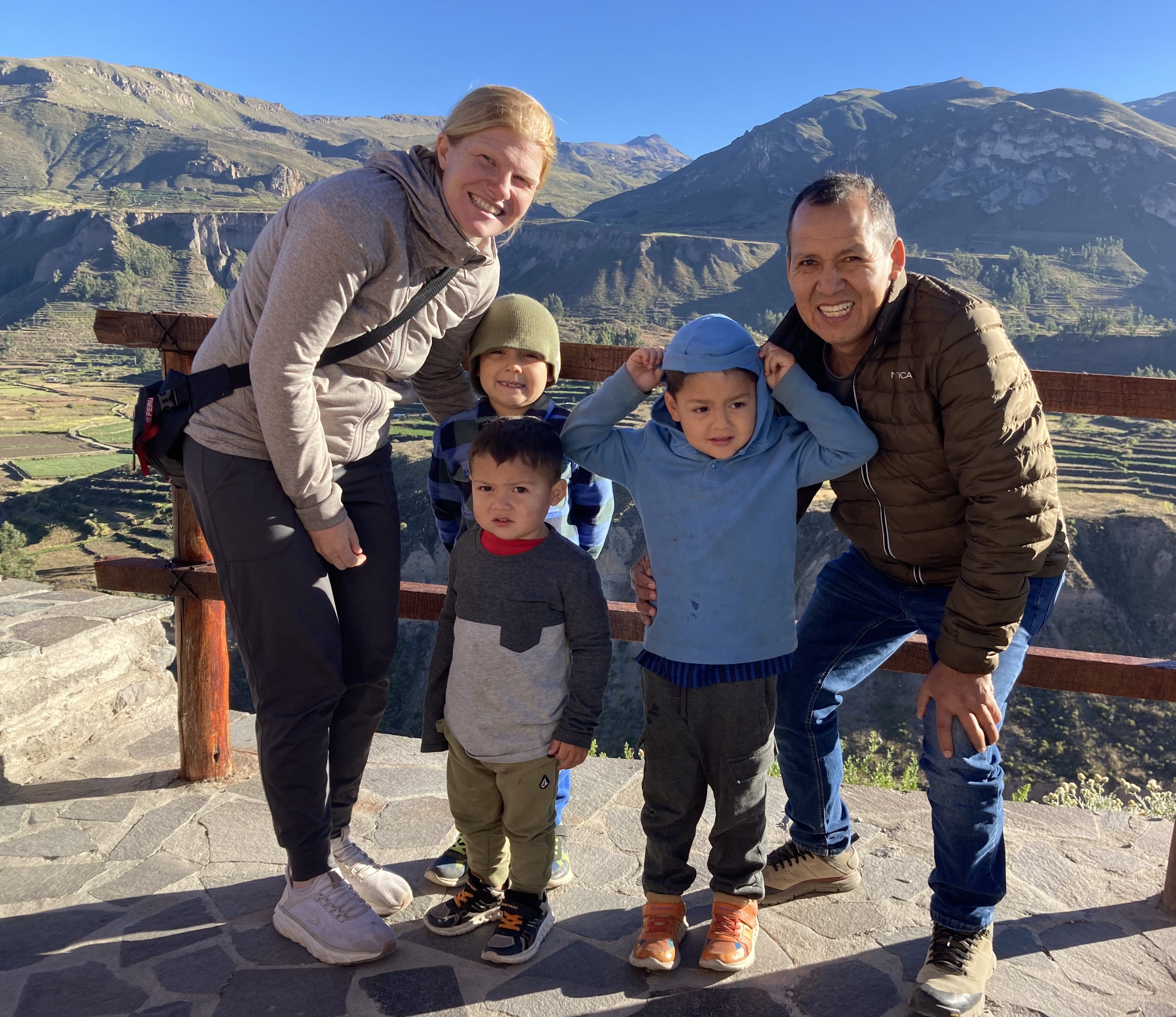
We make stop after stop. We eat breakfast, we take photos with alpacas, we take in the view, we learn about the local pisco, swim in the hot springs, and encounter souvenirs that start to look the same. Our movements are choreographed and known by all. It feels summer-camp-like, the logistics rehearsed and fine-tuned. We wander off at lunch and find ice cream and a playground, so that we can feel the day is our own. We are not the only van; the white vans line up at the condor viewing. I look for the Jesus photo hanging from the mirror at our appointed return time, our van’s distinctive detail.
We buy the boys key chains for their backpacks- a condor, a llama, and a coin purse. Enzo names a price- 5 soles each. She accepts, and Leifer and I know it’s more than we should pay. But she’s nice with us and throws in two extra keychains.
The condors yield to the currents rather than fighting what’s there. I wonder why I resist our circumstances, in limbo with no papers. I think of the year behind me. I carried so much guilt. I couldn’t shake it. I feel guilty for taking the kids to California and leaving Leifer to fend for himself. I feel guilty for not making a wage. I feel guilty for leaning on others for support. I wish we were in a position to contribute more. I want desperately to shake it- to find the currents we can ride.
Once we returned to Abuelita’s, the boys went outside and set about playing for the day. Leifer has a project building a bookshelf. I unpack and start laundry. We have made another home, and that’s something. Looking for just one home hasn’t worked. Perhaps it was never realistic when we are a union of two very different places. We had sacrificed and reduced one for the other. Both places now feel vivid in our lives, each carrying its own weight. I want to leave last year’s disruption behind us and begin rebuilding.
I write these pieces while caring for my family and building a life between places.
If you’d like to support that work, you can here:
Venmo: @Abby-Stott (last four digits of my phone number- 4606)
Your support helps me keep writing.
I love the picture. I love the happy smiles.
When I read your words, I see everything you write about as a watercolor painting. It’s splendid and simple and gut wrenching and inspiring. And so real.